

Biometric Sensors Market to Reach US$ 42.0 Billion by 2033 | Growing at 10.1% CAGR
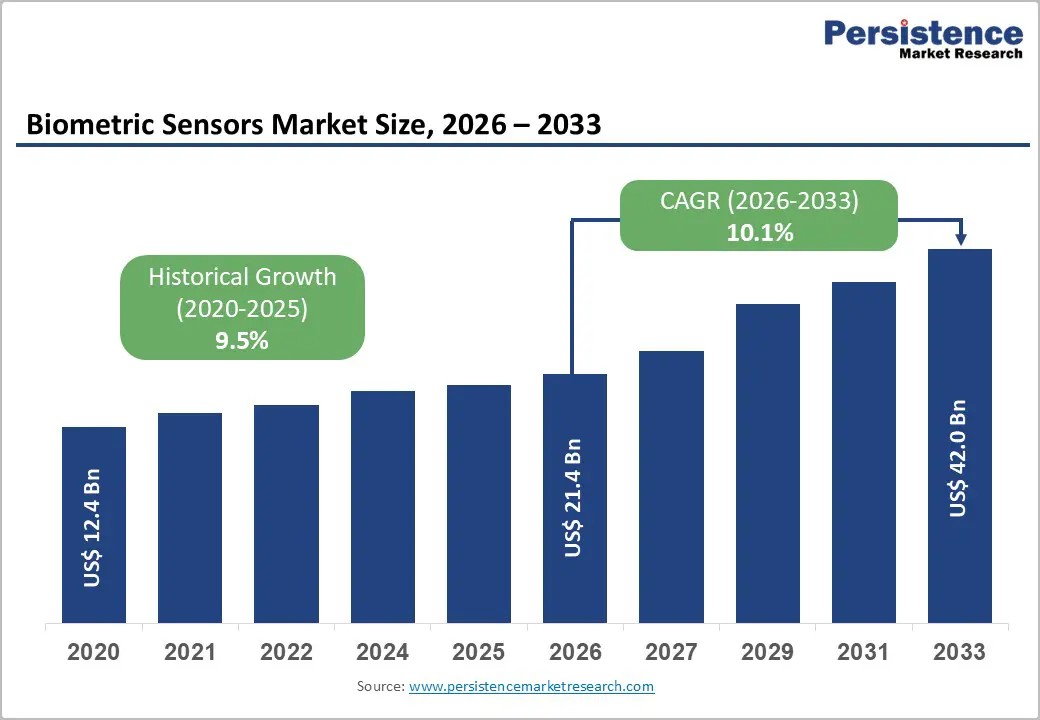
The biometric sensors market grows from US$21.4 Bn in 2026 to US$42.0 Bn by 2033, expanding at a CAGR of 10.1% during the forecast period (2026–2033)
BRENTFORD, ENGLAND, UNITED KINGDOM, February 18, 2026 /EINPresswire.com/ -- The global biometric sensors market is entering a high-growth phase, fueled by intensifying cybersecurity threats, large-scale government identification programs, and rapid integration into consumer electronics and financial systems. The market is projected to be valued at US$ 21.4 billion in 2026 and is expected to reach US$ 42.0 billion by 2033, expanding at a CAGR of 10.1% between 2026 and 2033.
Biometric authentication is transitioning from optional security enhancement to foundational identity infrastructure. With increasing data breaches and digital fraud incidents worldwide, enterprises and governments are rapidly adopting biometric solutions to ensure secure, non-transferable, and auditable identity verification.
𝐆𝐞𝐭 𝐚 𝐒𝐚𝐦𝐩𝐥𝐞 𝐏𝐃𝐅 𝐁𝐫𝐨𝐜𝐡𝐮𝐫𝐞 𝐨𝐟 𝐭𝐡𝐞 𝐑𝐞𝐩𝐨𝐫𝐭: https://www.persistencemarketresearch.com/samples/33611
Market Overview and Growth Drivers
Rising Security Threats and Identity Theft Concerns
Escalating cybersecurity breaches and digital identity fraud are primary catalysts for biometric adoption. According to the 2023 Annual Data Breach Report by the Identity Theft Resource Center (ITRC), U.S. data compromises surged to 3,205 cases in 2023 compared to 1,801 in 2022.
Traditional password-based authentication systems are increasingly viewed as inadequate. Biometric sensors, leveraging unique physiological and behavioral traits such as fingerprints, facial patterns, iris structures, and voice signatures, provide:
Government Initiatives Accelerating Adoption
Large-scale national identity programs are transformative growth drivers.
India’s Aadhaar initiative, managed by the Unique Identification Authority of India, has enrolled over 1.3 billion citizens, creating the world’s largest biometric database. The program integrates fingerprint and iris authentication into public services, welfare distribution, banking, and digital governance.
Similarly, the European Union’s Entry/Exit System (EES), operational from October 2025 with full rollout expected by April 2026, mandates biometric registration of non-EU travelers across Schengen states. This requires large-scale deployment of fingerprint scanners and facial recognition systems at border checkpoints.
Such initiatives significantly expand procurement volumes for biometric hardware, software, and integrated platforms.
Market Restraints
Privacy Regulations and Data Protection Compliance
Biometric data is classified as sensitive personal information under strict regulatory frameworks like the EU’s GDPR. Organizations must implement:
Encrypted storage systems
Restricted access controls
Transparent consent mechanisms
Continuous security audits
Compliance costs and operational complexity may slow adoption in heavily regulated regions, particularly for SMEs lacking specialized legal infrastructure.
Vulnerability to Spoofing and Presentation Attacks
Biometric systems remain susceptible to spoofing attempts using fabricated fingerprints, 3D masks, and AI-generated deepfake facial representations. Research indicates that over 80% of tested fingerprint scanners can be compromised using materials such as silicone or gelatin.
This has accelerated innovation in:
Liveness detection algorithms
Multi-modal authentication systems
AI-driven anti-spoofing technologies
Behavioral biometric fusion
Organizations in high-security sectors remain cautious, demanding continuous improvements in accuracy and fraud resistance.
Category-Wise Market Analysis
Sensor Type Insights
Optical sensors dominate the market with an estimated 52.8% share in 2025. Their leadership stems from:
High-resolution imaging capabilities
Cost-effective production
Seamless smartphone integration
Proven reliability in access control systems
Their scalability and mature supply chain infrastructure make them the backbone of consumer and enterprise biometric deployments.
Scan Type Insights
Facial recognition is the fastest-growing biometric modality. Advancements in computer vision, 3D sensing, and AI-based pattern analysis have improved accuracy across diverse lighting and environmental conditions.
Key growth areas include:
Smartphone authentication
Law enforcement identification
Airport screening
Retail verification
Smart city surveillance
Its contactless nature makes it especially attractive in post-pandemic environments.
Application Insights
Payment & Fintech represents the fastest-growing application segment. Financial institutions increasingly integrate fingerprint and facial authentication into:
Mobile banking apps
Digital wallets
Biometric ATMs
Digital KYC processes
India’s biometric-enabled UPI payments illustrate how authentication time can be reduced while maintaining compliance standards. In select European markets, biometric banking adoption exceeds 85%, highlighting rapid digital transformation.
End-User Insights
Government & Defense remains the dominant end-user segment, driven by:
National ID systems
Border modernization
Criminal investigation databases
Public security infrastructure
In the United States, facial recognition systems have been deployed across more than 20 airports, enhancing passenger processing efficiency and security.
𝐃𝐨 𝐘𝐨𝐮 𝐇𝐚𝐯𝐞 𝐀𝐧𝐲 𝐐𝐮𝐞𝐫𝐲 𝐎𝐫 𝐒𝐩𝐞𝐜𝐢𝐟𝐢𝐜 𝐑𝐞𝐪𝐮𝐢𝐫𝐞𝐦𝐞𝐧𝐭? 𝐑𝐞𝐪𝐮𝐞𝐬𝐭 𝐂𝐮𝐬𝐭𝐨𝐦𝐢𝐳𝐚𝐭𝐢𝐨𝐧 𝐨𝐟 𝐑𝐞𝐩𝐨𝐫𝐭: https://www.persistencemarketresearch.com/request-customization/33611
Regional Insights
North America
North America leads the global biometric sensors market with a 32% share. The region benefits from:
Advanced digital infrastructure
High R&D investment
Mature fintech ecosystem
Government-backed identity platforms
Federal systems such as the Federal Bureau of Investigation’s Next Generation Identification platform support large-scale biometric databases. Meanwhile, companies like Qualcomm Technologies continue innovating advanced fingerprint sensor technologies for smartphones and enterprise devices.
Healthcare and financial institutions are major contributors to sustained demand in the region.
Europe
Europe’s growth is driven by coordinated EU-level security modernization efforts and strict data governance policies. Countries including Germany, France, the United Kingdom, and Spain are integrating biometric verification into banking, digital identity systems, and border control programs.
Regulatory oversight under GDPR and the forthcoming EU AI Act encourages privacy-centric biometric solutions emphasizing ethical design and transparent governance.
Asia Pacific
Asia Pacific is the fastest-growing region, projected to expand at a CAGR exceeding 12%. Growth is driven by:
National ID programs
Smart city initiatives
Rapid smartphone penetration
Expanding fintech ecosystems
China leads in biometric surveillance infrastructure, while India’s Aadhaar program anchors digital identity expansion. Japan and South Korea continue integrating biometrics across banking, transportation, and defense systems.
The region’s large population base and manufacturing strength create significant opportunities for scalable biometric deployments.
𝐁𝐮𝐲 𝐍𝐨𝐰 𝐭𝐡𝐞 𝐃𝐞𝐭𝐚𝐢𝐥𝐞𝐝 𝐑𝐞𝐩𝐨𝐫𝐭: https://www.persistencemarketresearch.com/checkout/33611
Competitive Landscape
The biometric sensors market features a moderately concentrated structure, with established players maintaining strong global footprints. Key companies include:
IDEMIA
NEC Corporation
Thales
Suprema Inc.
Fingerprint Cards AB
Goodix Technology
Conclusion
The biometric sensors market is transitioning from a specialized security technology segment to a critical pillar of global digital identity infrastructure. With market value projected to reach US$ 42.0 billion by 2033, the industry’s 10.1% CAGR reflects strong demand across government, fintech, healthcare, and consumer electronics sectors.
While privacy regulations and spoofing vulnerabilities pose challenges, AI-driven innovation, multimodal integration, and expanding application domains are unlocking substantial growth opportunities. As digital ecosystems become increasingly interconnected, biometric authentication will serve as a foundational technology for secure, scalable, and seamless identity verification worldwide.
Related Reports:
Face and Voice Biometrics Market
U.S. Emergency Management Services Market
Pooja Gawai
Persistence Market Research
+1 646-878-6329
email us here
Visit us on social media:
LinkedIn
Instagram
Facebook
YouTube
Legal Disclaimer:
EIN Presswire provides this news content "as is" without warranty of any kind. We do not accept any responsibility or liability for the accuracy, content, images, videos, licenses, completeness, legality, or reliability of the information contained in this article. If you have any complaints or copyright issues related to this article, kindly contact the author above.
